Cox: Supreme Court Materially Constricts Secondary Liability For Copyright Infringement (2026)
Tuesday, 31 March 2026
Last week, the U.S. Supreme Court, in Cox Communication, Inc. v. Sony Music Entertainment (No. 24-171, March 25, 2026), substantially narrowed service providers’ potential secondary liability for their users’ copyright infringements, by clarifying that mere knowledge alone that a service will be used to infringe is insufficient to establish the required intent for secondary liability.
- Published in Intellectual Property Law
No Comments
U.S Supreme Court Warhol Foundation Decision on Copyright Fair Use, 5 Maryland Bar Journal, Issue 2, p. 50 (2023)
Saturday, 02 December 2023
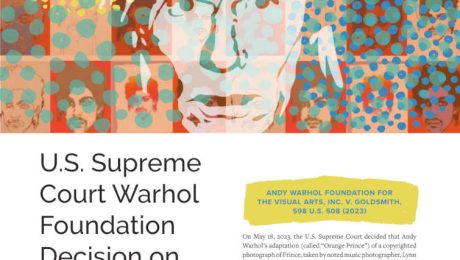
On May 18, 2023, the U.S. Supreme Court decided that Andy Warhol’s adaptation (called “Orange Prince”) of a copyrighted photograph of Prince, taken by noted music photographer, Lynn Goldsmith, infringed her work and was not fair use.1 Under the Copyright Act, the owner of a work has an exclusive bundle of rights, and secondary users have the burden of proof to show that their otherwise infringing adaptation of the owner’s work is excused as a fair use. The scope of fair use is a complex, fact-intensive, contextual inquiry.
Importantly, because the Andy Warhol Foundation (AWF) didn’t challenge the Second Circuit’s holding that the second through fourth fair use factors favored Goldsmith, the only issue before the Court was whether the first factor—“the purpose and character of the use, including whether such use is of a commercial nature or is for nonprofit educational purposes,”2 weighed in favor of AWF’s commercial licensing of Orange Prince to Condé Nast.
- Published in Intellectual Property Law
Web Images Aren’t Always Free – The Case For Clearing Rights (2013)
Thursday, 15 August 2013
When you see an inviting Internet visual image which seems ripe for the taking, consider that it may not be freely available… Increasingly, I am being contacted by clients on the receiving end of copyright cease and desist letters based on their unlicensed use of visual images in digital works. Not clearing rights is simply
- Published in Copyright Law, Intellectual Property Law, Internet, Rights Clearance
Reading the Tea Leaves: ISP Obligations After The Second Circuit’s Viacom v. YouTube Decision (2012)
Wednesday, 12 December 2012
Introduction Although the Digital Millennium Copyright Act (DMCA) does not require service providers to actively monitor their sites for infringing content, a provider with” knowledge” of infringing activities must act quickly to remove or disable access to these materials. Knowledge comes in two flavors- – actual and imputed – -but after the Second Circuit’s decision,


